Car battery: How long does it last?

How long does a car battery last? – the most important things in brief
-
Life of a car battery: According to the ADAC, a starter battery, regardless of the battery type, has a shelf life of between 4 and 5 years.
-
Extend battery life: With a few tips, you can extend the life of a car battery, e.g. avoid short distances or choose the right battery right away.
-
Electric Car Battery Life: E-cars have a larger energy storage system, so the batteries last longer – 8 years or up to 160,000 kilometers.
-
Car battery on short distances: Drivers who only drive short distances permanently and never long distances should charge the battery every 3 months with a charger.
Information on the service life and durability of car batteries
According to the ADAC, you can expect a lifespan of 4 to 5 years for your car battery. There is no difference between the different types of car batteries, such as e.g. Gel-free or maintenance-free batteries.
Regardless of the type of battery, a standard starter battery with a voltage of 12 lasts an average of 4 to 5 years. However, some behaviors can lead to premature battery death, while some drivers may brag about using the same battery for 15 years. The fact is that the car battery is one of the most common causes of breakdowns and the main reason for loss of mobility. This is super annoying for you and your wallet and also a real environmental problem. This is because defective batteries have to be disposed of and recycled at great expense. The professionals in our partner workshops will be happy to support you in changing and disposing of your car battery.
Your advantages with the HUK car service
- Partner workshop near you
- Easy online booking
- secure payment
- Absolute cost certainty
- Usual HUK-COBURG quality
How long does a car battery last on average?
Under ideal conditions, a car battery lasts between 4 and 5 years on average. However, various factors influence how long a new car battery lasts. If you often drive short distances, this leads to a higher load on the battery and reduced durability. Weather influences such as high or low temperatures or whether you are an infrequent driver also determine the service life of the car battery.
Why does a car battery break in the first place?
As many drivers have to discover, car batteries often do not last long. The reason for this is that the number of charging and discharging cycles, which is limited for each battery. A common cause of a weakening battery is a defective alternator or a defective charge controller. A worn V-belt can also be a cause of a car battery breaking. This is usually announced by a clearly perceptible squeaking from the engine compartment.
Car batteries are particularly stressed in winter: In the cold, the chemical processes inside the battery take place more slowly. In addition, the discharge produces lead sulphate in the battery. This lead sulfate forms crystals when the battery is not fully charged. Over time, these crystals combine to form larger and larger deposits. This reduces the active surface area of the electrodes, which in turn leads to poorer responsiveness. Usually, after about 4 years, so much area has become unusable that you notice a significant reduction in the performance of the battery. While driving, the crystals can fall off the electrodes and form a layer of mud at the bottom of the cell. If this layer is high enough to touch the two electrodes, a short circuit follows and the battery is permanently destroyed.
The crystals can only be destroyed by regular, long charging of the car battery. Unfortunately, a vicious circle opens up here: This only works if there are no crystals at all. You can find out how to make your car battery last a long time in our compiled tips.
10 tips to extend the life of your car battery
A lot of power-hungry on-board electronics puts a strain on the capacity of your power storage system. Just as frequent short distances and a lack of knowledge about self-discharge, deposits of lead sulphate and dirt on the electrodes. Failure to take precautions for the winter can also lead to your battery life being far below the service life claim advertised by the manufacturer. To prevent this from happening to you, here is a list of the ideal conditions that prevent premature aging of your lead-acid battery and help you to make maximum use of its durability and number of possible charging cycles.
10 tips to extend the life of your car battery
A lot of power-hungry on-board electronics puts a strain on the capacity of your power storage system. Just as frequent short distances and a lack of knowledge about self-discharge, deposits of lead sulphate and dirt on the electrodes. Failure to take precautions for the winter can also lead to your battery life being far below the service life claim advertised by the manufacturer. To prevent this from happening to you, here is a list of the ideal conditions that prevent premature aging of your lead-acid battery and help you to make maximum use of its durability and number of possible charging cycles.
1. Choosing the right car battery
Choosing the right type of battery for your carand your driving habits are the basic prerequisites for extending the useful life of your battery. In our guide you will find everything you need to know about the different types of batteries and which car battery is the right one for your car.
-
Car batteries for short distances: If you know from the outset that you will mainly be driving in city traffic and therefore mostly on short distances, then it is advisable to use a more expensive but suitable AGM battery the next time you change the battery. Due to its design, this has a lower internal resistance than standard lead-acid batteries over its entire service life. This means that it ensures faster charging over short distances and, in contrast to standard lead-acid batteries, has three times the cycle life. You should also choose the battery that is too big rather than too small, so that you don't have to accept any loss of comfort in the cold, even when using modern consumers such as seat heating and the like.
-
Car batteries for automatic start-stop: In vehicles with automatic start-stop systems, the engine stops several times while driving. Every starting process is associated with high energy consumption. In order to prevent repairs and loss of mobility, the use of at least an EFB battery, but preferably an AGM battery, is recommended. Both stand for a long cycle life. The AGM battery also scores with fast charging via the alternator, as it builds up a low internal resistance over its entire service life. With low sulfation, the current can flow freely and the battery life is extended.
You can also find everything you need to know about the different battery types in our guide.
2. Alternate short and long distances
If you still have a standard lead-acid battery installed, it is advisable to alternate short and long distances. For example, if you and your partner both have a car but different driving habits, it is a good way to change vehicles every week. In this way, each battery is discharged in a balanced way and recharged via the alternator.
3. Perform trickle loads
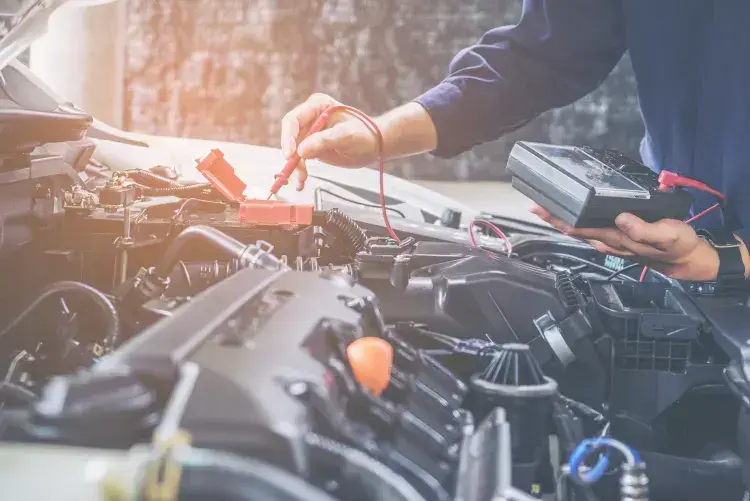
If you mainly drive short distances, regular trickle charging through a battery charger can extend the life of your battery. As a rule of thumb on the part of well-known manufacturers, 3 months is considered the time frame for a trickle charge for frequent short distances. It is more accurate and needs-based to check the battery with a battery tester. Such a meter performs a reliable battery test and provides information about the remaining capacity of your battery. Some battery testers are available as a combined charger. After the battery test has been carried out, you can then conveniently use the function as a battery charger and after a few hours your battery will have full capacity again. You can also find out how to charge a car battery correctly in our guides.
4. Extend service life with battery pulser
Some car owners swear by the use of battery pulsers. These are attached to the battery over several hours and are intended to release sulfation by means of strong, high-voltage pulses. These occur as deposits on the battery modules inside the battery, especially in standard lead-acid batteries. In the long term, they lead to increased internal resistance and aging of the battery due to a decrease in capacity. If the car is parked for too long, it can lead to deep discharge of the car battery.
A battery pulser can help loosen the deposits. Normal chargers usually do not have the necessary pulse function to repair an already existing battery damage. Battery pulsers are like a wellness cure for your battery. However, since they require experience in handling your car and electricity during installation and use, we recommend that you contact professionals if you have problems with your battery. Our experts in the partner workshops of HUK-Autoservice will be happy to advise you on topics such as self-discharge and deep discharge, so that you can get by next winter without a jump start and breakdown service.
5. Consumers choose consciously
Modern cars in particular often have a variety of vehicle electrics. The need for heated seats or heated exterior mirrors is debatable. Especially in winter in cold weather conditions, however, you should only switch on the consumers in your car after you have started the engine. Even after that, it is advisable to select the on-board electronics spartan, especially on short journeys, in order to extend the life of your car battery. Heated front and rear windows, for example, require around 120 watts, fog lights around 100 watts and the comfortable seat heating 60 watts. Unfortunately, many consumers also draw power when stationary and are the number one cause of breakdowns after a long period of inactivity. You can reduce these creeping discharges by identifying the power guzzlers according to your car's user rules and switching them off if necessary. Our partner workshops from HUK-Autoservice can help you with this.
However, if you don't want to miss out on any comfort, you should choose your battery rather large and perform regular trickle charging with a charger.
6. Cold protection for your battery
In winter, you can easily prevent reduced performance and battery damage by protecting it against sub-zero temperatures with a special thermal cover. According to some manufacturers, temperatures around freezing point can already cause performance losses of up to 40 percent on your lead-acid battery. Just don't forget to take off the thermal cover in spring and warmer conditions.
7. Battery care prevents leakage current
An absolute battery killer are dirty electrodes, contacts and connections. Leakage currents can cause the gradual discharge of your battery via damp dirt. Therefore, make sure that all parts are clean and grease the poles of your battery well, at least for winter, with pole grease (protective grease against acid).
Especially in winter, you should pay special attention to your battery. Treat her to a wellness cure with cleansing, pole grease and regular trickle charges. So you stay relaxed mobile even in sub-zero temperatures.
8. Prepare the car for longer periods of time
To prevent the formation of lead sulphate and thus the loss of service life of your battery, you should remove the battery when you plan to stand still. In a temperature-protected environment and connected to a charger with a maintenance function, you effectively prevent deep discharge and premature aging processes. In this way, you extend the useful life of your energy storage.
9. Take warning signs of a weakening battery seriously
Before the total battery damage, the first signs that the capacity limit of your battery is dropping can already be seen in the use of your vehicle. If the engine stutters when starting, the headlights flicker or the parking light becomes weaker when the engine is running, you should take action immediately! Immediately attach the test device to the terminal clamps and do not hesitate to perform a trickle charge with your battery charger. If that doesn't help either, you should take your car to a garage and have professionals look for hidden reasons. For example, a defective alternator regulator can also cause the car battery to fail unusually quickly.
10. Measure the acid level of the battery
If the measuring device shows low voltages despite regular use of the charger and your driving habits do not explain the rapid discharge processes, then it may be time to measure the acid level of your battery: To do this, fill one battery cell after the other with acid until a level of 3 to 6 millimeters above the upper edges of the separators is reached. Then let the battery rest for 20 to 30 minutes and only then measure the open-circuit voltage.
But be careful: Filling up the acid level can be accompanied by health damage such as chemical burns. Therefore, this is a battery repair that you are better off leaving to professionals.
Post a Comment for "Car battery: How long does it last?"